Cincinnati Bengals at Indianapolis Colts: 2018 Week 1 NFL Pick

Cincinnati Bengals (0-0) at Indianapolis Colts (0-0)

When I first looked at the week 1 lines back in late July, Cincinnati +3 at Indianapolis caught my eye immediately and I locked a small bet in at that number. The line has since shifted to +2, so I don’t like the Bengals as much, but I would still recommend betting them this week. I have these two teams 3 wins apart in my predictions, while this line suggests that the Bengals are only about a point better. The Colts get Andrew Luck back from injury, but have arguably the worst supporting cast in the NFL around him and Luck could easily be rusty early in the season.

The Bengals, on the other hand, have an improved offensive line and should get more out of their skill position talent, while their defense remains an above average unit. They are without linebacker Vontaze Burfict due to suspension to begin the season, but the Colts could also be without left tackle Anthony Castonzo with a hamstring injury, which would be a huge blow to an already shaky offensive line. The Bengals should be favored in this one and have a good chance to pull the “upset.”

Cincinnati Bengals 20 Indianapolis Colts 17 Upset Pick +115

Pick against the spread: Cincinnati +2

Confidence: Medium

Jacksonville Jaguars at New York Giants: 2018 Week 1 NFL Pick

Jacksonville Jaguars (0-0) at New York Giants (0-0)

The Jaguars won 10 games last season and they were even more dominant than that suggests, as they finished 2nd in first down rate differential, 3rd in point differential, and came within a few plays of making the Super Bowl. It helped that they had an easy schedule and relatively few injuries, but they remain healthy for now and open the season with a relatively easy game against the Giants.

At first glance, the Giants look much improved with the addition of Saquon Barkley and the return of Odell Beckham from injury, but they still have major problems on the offensive line and at quarterback and their defense is not nearly as good as it was when they made the postseason in 2016, especially with Olivier Vernon out for the start of the season. The Jaguars should be favored by more than a field goal. Their average margin of victory in 2017 was 20.2 points, so this game could easily not be close.

Jacksonville Jaguars 24 New York Giants 16

Pick against the spread: Jacksonville -3

Confidence: High

Pittsburgh Steelers at Cleveland Browns: 2018 Week 1 NFL Pick

Pittsburgh Steelers (0-0) at Cleveland Browns (0-0)

The Steelers went 13-3 last season, but were not as good as their record suggested, as they went 8-2 in games decided by 7 points or fewer. They especially struggled down the stretch, winning just 2 games by more than 4 points in the final 8 games of the season and then losing in their first playoff game at home to Jacksonville. That was in large part due to the loss of linebacker Ryan Shazier with injury and they did not adequately replace him this off-season. On top of that, the Steelers will be without running back Le’Veon Bell for at least the first game of the season, due to a holdout.

The Steelers may still win double digit games this season due to a weak schedule, but they should not be favored by 4.5 points on the road against a much improved Browns team. Outside of the turnover margin, the Browns were not a terrible team in 2018 and the switch from one of the most turnover prone quarterbacks in the NFL in Deshone Kizer to one of the least in Tyrod Taylor should at least make this team respectable, much like Alex Smith did when he arrived in Kansas City. They also added Jarvis Landry and should once again have a capable defense. If the Steelers win this game, I would expect it to be close like many of their wins were in 2017. I like the Browns’ chances of winning outright as well.

Cleveland Browns 24 Pittsburgh Steelers 23 Upset Pick +180

Pick against the spread: Cleveland +4.5

Confidence: Pick of the Week

Atlanta Falcons at Philadelphia Eagles: 2018 Week 1 NFL Pick

Atlanta Falcons (0-0) at Philadelphia Eagles (0-0)

I will keep this brief because I am doing this late, but you can click on the team name to see a preview of each team. I have the Eagles as my highest ranked team coming into the season and would likely have them favored by 4.5-5 points if they were at full strength. However, they will not have Carson Wentz, Alshon Jeffery, or Nigel Bradham in this game, which obviously hurts. This line is Atlanta -1, which is about where I’d have it, so we aren’t getting any real line value either way. I am taking the Eagles simply because defending champs tend to do well at home in week 1 Thursday Night games, going 9-3 ATS since 2004. I would not recommend betting this game though. I will have the rest of the week 1 picks on Friday and Saturday as usual.

Philadelphia Eagles 24 Atlanta Falcons 23 Upset Pick +100

Pick against the spread: Philadelphia +1

Confidence: None

2018 NFL Season Predictions

AFC East

New England 13-3

NY Jets 4-12

Miami 4-12

Buffalo 3-13

AFC North

Pittsburgh 10-6

Cincinnati 8-8

Cleveland 7-9

Baltimore 6-10

AFC South

Tennessee 10-6

Jacksonville 10-6

Houston 8-8

Indianapolis 5-11

AFC West

LA Chargers 10-6

Denver 9-7

Kansas City 7-9

Oakland 6-10

NFC East

Philadelphia 13-3

Dallas 8-8

Washington 8-8

NY Giants 4-12

NFC North

Green Bay 12-4

Minnesota 10-6

Chicago 9-7

Detroit 6-10

NFC South

Atlanta 11-5

New Orleans 11-5

Carolina 6-10

Tampa Bay 5-11

NFC West

LA Rams 10-6

Seattle 10-6

San Francisco 7-9

Arizona 6-10

AFC Wild Card

Tennessee over Denver

LA Chargers over Jacksonville

NFC Wild Card

Atlanta over Seattle

LA Rams over New Orleans

AFC Divisional

New England over Tennessee

LA Chargers over Pittsburgh

NFC Divisional

Philadelphia over LA Rams

Green Bay over Atlanta

AFC Championship

New England over LA Chargers

NFC Championship

Green Bay over Philadelphia

Super Bowl

New England over Green Bay

Pick Results

2017

Total Against the Spread: 139-119-8 (53.76%)

Pick of the Week: 11-6 (64.71%)

High Confidence Picks: 21-11-3 (64.29%)

Medium Confidence Picks: 33-33-1 (50.00%)

Money Picks (Medium Confidence and higher): 65-50-4 (56.30%)

Low Confidence Picks: 44-38-4 (53.49%)

No Confidence Picks: 30-31 (49.18%)

Upset Picks: 19-25 (43.18%)

All-Time (Since 2013)

Total Against the Spread: 691-607-36 (53.15%)

Pick of the Week: 51-34-2 (59.77%)

High Confidence Picks: 80-59-6 (57.24%)

Medium Confidence Picks: 199-152-6 (56.58%)

Money Picks (Medium Confidence and higher): 330-245-14 (57.22%)

Low Confidence Picks: 189-183-13 (50.78%)

No Confidence Picks: 172-179-9 (49.03%)

Upset Picks: 107-136 (44.03%)

Perfect 53 Man Roster

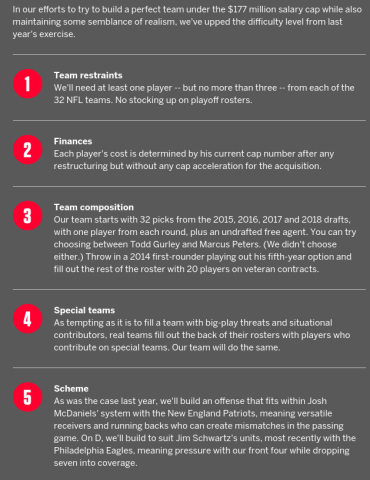
For the second year in a row, Bill Barnwell has released his perfect 53-man roster. The idea is, following certain criteria, to build the best team you can fit under the NFL’s 177.2 million dollar cap. This is my version of the team. Below are the criteria in Barnwell’s own words.

QB Carson Wentz PHI $7,275,365 2016 1st
QB Dak Prescott DAL $725,848 2016 4th

Barnwell has Wentz and Prescott too, but they’re really the obvious choices here, so I’m not switching anything up here. 23 quarterbacks have cap numbers of 10+ million. Wentz and Prescott do not even combine to take up 10 million on the cap. Wentz could have another MVP caliber season in 2018 if he’s healthy and Prescott gives good insurance in case he’s not. The one difference between my team and Barnwell’s is that I didn’t see the need to have a 3rd quarterback behind these two. Why waste a roster spot on a 3rd string quarterback like Brandon Weeden when you can use it to fill out your special teams?

RB Rex Burkhead NE $2,312,500 Veteran
RB David Johnson ARZ $2,066,844 2015 3rd
RB Alvin Kamara NO $878,193 2017 3rd
RB Aaron Ripkowski GB $731,599 2015 6th
RB Raheem Mostert SF $705,000 2015 undrafted

Johnson and Kamara are on Barnwell’s team as well, but they form a deadly one-two punch at running back for less than 3 million combined and they are both the best draft pick from their respective rounds, so they’re no brainer additions to this team. Where I differed from Barnwell is that I did not add a 3rd running back like Jordan Howard, opting instead to add a veteran jack of all trades like Rex Burkhead. Mostert plays special teams and fulfills my requirement for both a 2015 undrafted free agent and a San Francisco 49er, while Ripkowski is one of the better fullbacks in the league and is arguably the most accomplished player from the 2015 6th round.

WR Antonio Brown PIT $7,955,000 Veteran
WR Michael Thomas NO $1,396,083 2016 2nd
WR Tyreek Hill KC $704,996 2016 5th
WR Antonio Callaway CLE $659,463 2018 4th
WR Keelan Cole JAX $556,333 2017 undrafted

Passing on Jordan Howard allows me to use the 2016 5th round pick spot on Tyreek Hill, who can be a threat both on offense and in the return game. Hill combines with Antonio Brown and Michael Thomas, who finished 1st and 6th in receiving yardage last season, to form a deadly 3 wide receiver package. Brown signed a huge extension last off-season, but still has a manageable cap number after a restructure, while Thomas was a steal in the 2nd round in 2016 and could take another step forward in 2018, now in his 3rd season in the league. Callaway and Cole are young depth receivers who fill my requirements for a 2018 4th round pick and a 2017 undrafted free agent respectively. Cole finished 4th among rookies in receiving yards in 2017, despite going undrafted, while Callaway is a first round talent who fell for off-the-field reasons and can also contribute as a return man.

TE Travis Kelce KC $9,955,900 Veteran
TE Zach Ertz PHI $4,937,500 Veteran
TE David Morgan MIN $663,864 2016 6th

Kelce and Ertz make a dangerous veteran tight end duo, while Morgan has developed into one of the best run blocking tight ends in the league and can have a role on this team in short yardage situations. He also fulfills my requirement for a 2016 6th round pick.

OL David Bakhtiari GB $11,075,000 Veteran
OL Travis Frederick DAL $6,275,000 Veteran
OL Zack Martin DAL $6,000,000 Veteran
OL Ricky Wagner DET $5,900,000 Veteran
OL David DeCastro PIT $5,687,500 Veteran
OL Andrew Norwell JAX $5,000,000 Veteran
OL Trent Brown NE $1,907,000 2015 7th
OL Chase Roullier WAS $591,792 2017 6th

This is a veteran heavy line and where I spent the most money, but all of these players are great values. The top-6 are all among the best in the league at their position. From left to right I would start Bakhtiari, Norwell/DeCastro, Frederick, Martin, and Wagner. Brown is an above average starter as well and would be a very valuable swing tackle. He’s also easily the best player from the 2015 7th round. Rouillier made 7 starts at center for the Redskins in 2017 and is expected to remain the starter in 2018, making him the most accomplished player from the 2017 6th round pick. He also has the versatility to play guard, so he provides this line with valuable depth.

ID Aaron Donald LAR $6,892,000 2014 1st
ID Leonard Williams NYJ $5,928,003 2015 1st
ID Grady Jarrett ATL $1,968,964 2015 5th
ID Michael Pierce BAL $633,334 2016 undrafted
ID Maurice Hurst OAK $559,761 2018 5th

Unlike my offensive linemen, my interior defensive linemen are all still on their rookie deals. Donald is the most expensive of the bunch at 6.892 million, but that’s a bargain price for the reigning Defensive Player of the Year and he’s the obvious choice among the 2014 1st round picks who are still on their 5th year option. Williams and Jarrett are talented every down interior defensive linemen too, while Pierce has developed into one of the better run stuffing defensive tackles in the league and is the easy choice among the 2016 undrafted free agents. Hurst is also an easy choice out of the 2018 5th round picks, as he has first round talent, but long-term health concerns. As stacked as the rest of this roster is, I’m willing to take the risk and he fills my requirement for an Oakland Raider.

ED Von Miller DEN $10,125,000 Veteran
ED Carlos Dunlap CIN $7,300,000 Veteran
ED Danielle Hunter MIN $5,063,806 Veteran
ED Trey Flowers NE $2,046,733 2015 4th
ED Carl Lawson CIN $718,153 2017 4th
ED Duke Ejiofor HOU $526,314 2018 6th

Von Miller is the highest paid defensive player in the league, but his cap number is manageable for 2018 and he’s one of the top players in the league, so he’s a no brainer addition to this team. Dunlap and Hunter are also great values, Dunlap because he’s been underpaid for years on 5-year, 39.37 million dollar deal and Hunter because he just signed a massive extension with bigger cap hits in later years. Flowers fills my requirement for a 2015 4th round pick, making the team just over his teammate Shaq Mason, who wouldn’t have filled as big of a role as a reserve guard. Flowers can line up both inside and outside in passing situations. Lawson is a pass rush specialist who had 8.5 sacks and 11 hits on 389 pass rush snaps as a 4th round rookie last season and can also line up at linebacker in base packages. Ejiofor can play special teams and fills my requirement for a 2018 6th round pick and a Houston Texan.

LB Bobby Wagner SEA $13,600,000 Veteran
LB Lavonte David TB $8,750,000 Veteran
LB Roquan Smith CHI $3,359,485 2018 1st
LB Nigel Bradham PHI $2,000,000 Veteran
LB Skai Moore IND $718,153 2018 undrafted
LB Tyler Matakevich PIT $645,762 2016 7th

Bobby Wagner has the highest cap number on this team and he and Lavonte David take up about an eighth of the cap between them, but they are arguably the top 4-3 outside linebacker and 4-3 inside linebacker in the NFL and will play every down on this defense. They also fill my requirement for a Buccaneer and a Seahawk. The Eagles had to get creative under the cap to keep Bradham, so he has a cap number of just 2 million, which is a bargain for a player of his caliber. He can play every down, but would only need to be the 3rd linebacker in base packages on this team. He may even face competition from Roquan Smith, who seemed like the best value of any of the 2018 1st round picks. None of the rookies would start on this team, but Smith can be a special teams demon and provide depth at all 3 spots and doesn’t cost nearly as much as the guys who went in the top-5. Moore and Matakevich are special teamers who fill my requirement for a 2018 undrafted free agent and a 2016 7th round pick.

CB Casey Hayward LAC $6,833,334 Veteran
CB Tre’Davious White BUF $2,293,434 2017 1st
CB Josh Jackson GB $1,137,473 2018 2nd
CB Desmond King LAC $624,998 2017 5th
CB Greg Stroman WAS $498,944 2018 7th

Hayward broke out as one of the top cornerbacks in the league after signing a 3-year, 15.3 million dollar deal with the Chargers two off-seasons ago and, even on his new 3-year, 33.25 million dollar extension, he is still a good value and his big cap numbers don’t come until after this season. White was just as good as Marshon Lattimore as a rookie, but because he went 27th rather than 11th his cap number is significantly less (Lattimore’s is $3,490,809) and he fills my requirement for a Buffalo Bill. Josh Jackson was PFF’s highest rated player to fall into the 2nd round this year and can immediately push Desmond King, a 2017 5th round pick who broke out as a slot cornerback as a rookie, for a role. Stroman is a developmental prospect who had the 2nd lowest QB rating allowed among draft eligible cornerbacks in 2018.

S Michael Thomas MIA $1,981,250 Veteran
S Landon Collins NYG $1,947,450 2015 2nd
S Budda Baker ARZ $1,552,274 2017 2nd
S Kevin Byard TEN $1,008,831 2016 3rd
S Ronnie Harrison JAX $680,758 2018 3rd

It’s weird seeing Michael Thomas as my highest paid safety, but he’s a great special teamer and fills my requirement for a Miami Dolphin, so I don’t mind paying him under 2 million, while the rest of the bunch are just incredible values. Collins and Byard are an All-Pro duo on rookie deals. Baker wouldn’t start ahead of them, but can line up on the slot and at linebacker and can play special teams. Harrison was considered a good value in the 3rd round of the 2018 NFL Draft and can also have an immediate special teams role.

K Harrison Butker KC $555,000 2017 7th
P Marquette King DEN $1,666,666 Veteran
LS JJ Jansen CAR $1,055,000 Veteran

Butker was one of the best kickers in the league as a 7th round rookie in 2017, nailing 38 of 42 field goals, including 4 of 5 from 50+ yards, and 28 of 28 extra points. King has averaged 46.8 yards per punt on 426 punts in 5 seasons in the league, tied for 3rd highest among active punters with at least 300 punts over that time period, but has just the 18th highest cap number among punters. I don’t think long snappers have stats, but Jansen has been the Panthers’ long snapper since 2009, so he has to be doing something right and he fills my requirement for a Panther.

Philadelphia Eagles 2018 NFL Season Preview

Quarterback

The Eagles went from dead last in the NFC East at 7-9 in 2016 to Super Bowl Champions in 2017, but that shouldn’t have come as a huge surprise. The 2016 Eagles were better than their record suggested, as they finished with a +36 point differential that was better than 5 playoff teams. That was despite the fact that they were without stud offensive lineman Lane Johnson for most of the season with suspension (5-1 in the 6 games he played) and despite their underwhelming passing game, with rookie Carson Wentz throwing to one of the thinner receiving corps in the league. With Johnson returning from suspension, Wentz going into his second season in the league, and an improved receiving corps, a big jump in win total looked likely for them last season so, while they were not an obvious Super Bowl choice, it’s not a surprise that they had a strong season.

What pushed this team from a good team to a great one was their quarterback play. Carson Wentz took a huge statistical step forward in his second season in the league. After completing 62.4% of his passes for an average of 6.23 YPA, 16 touchdowns, and 14 interceptions as a rookie, Wentz completed 60.2% of his passes for an average of 7.49 YPA, 33 touchdowns, and 7 interceptions in his second season in the league and he almost doubled his rushing yardage from 150 to 299. Part of his statistical improvement came from having a much improved receiving corps, but there’s no denying Wentz was a vastly improved quarterback from year 1 to year 2. He jumped from 23rd to 5th among quarterbacks on Pro Football Focus and was considered an MVP front runner for most of the year.

Wentz is still only going into his age 26 season, so he could keep getting better, but his development hit a snag when he tore his ACL down the stretch last season. Backup quarterback Nick Foles was still able to guide this team to a Super Bowl victory, but Wentz’s injury could end up having long-term effects if he isn’t able to return at 100% right away and it complicates his development. He could easily have another strong season in 2018, but it could be a few years before he develops into a consistently top level quarterback.

Foles returns to the backup role with Wentz returning and, assuming Wentz is able to start week 1 as planned, Foles will be the first Super Bowl MVP in NFL history to begin the next season on the bench. Foles played incredibly well in both the NFC Championship and the Super Bowl, but he had some bad games late in the season and he’s been inconsistent throughout his career, so Wentz is the obvious choice to remain the starter. The Eagles finished the regular season 8th in first down rate at 35.91%, but were much better with Wentz under center, moving the chains at a 37.53% rate in his 13 starts, as opposed to 28.02% in Foles’ 3 regular season starts. Foles also struggled in their first post-season game.

Given Foles’ inconsistency, it’s a surprise that the Eagles were offered a high 2nd round pick for him in a trade this off-season, after he was available on just a 2-year, 11 million dollar deal as a free agent last off-season. The Eagles ended up turning that offer down because they are in win now mode and know the value of a reliable backup quarterback, even if they expect Wentz to return to form. This is arguably the best quarterback situation in the NFL and both quarterbacks are under contract inexpensively, which has allowed the Eagles to spend significant money at other positions.

Grade: A

Receiving Corps

Unlike many Super Bowl winners, the Eagles have a very good chance to repeat. Not only do they get their franchise quarterback back from injury, but they had almost no losses this off-season, with most of their key players already locked up on long-term deals. As important as their quarterback play was last season, this was also probably the best all-around team in the league last season and that allowed them to keep winning down the stretch, even when Foles had some underwhelming starts.

On the other hand, the Eagles have little financial flexibility long-term. They are already well over the 2019 cap, even before re-signing several key players who are scheduled to hit free agency next off-season. Wentz will also be eligible for an extension next off-season as well and will be due a massive increase at some point, assuming he returns to form. The Eagles kept this team together for 2018 and will compete for another Super Bowl, but 2019 might be a different story.

Top wide receiver Alshon Jeffery was scheduled for free agency this off-season, signed from the Bears last off-season on an incentivized one-year deal that ended up paying him 9.75 million, but the Eagles locked him up long-term on a 4-year, 52 million dollar extension late last season. Jeffery only had a 57/789/9 slash line, but he had much better chemistry with Wentz than Foles. In his 13 games with Wentz, he had a 52/732/8 slash line, which extrapolates to 64/901/10 over a 16 game season. Wentz also did not throw a single interception on a target to him all season, on 105 targets. Primarily a deep route runner, he should benefit the most from Wentz’s return.

Jeffery should also benefit from better health of his own. While he played all 16 games, he played through a shoulder injury for most of the season. From 2013-2016, he averaged a 85/1263/7 slash line per 16 games with the Bears. He probably won’t see the 9.1 targets per game he saw with the Bears, as part of a deep receiving corps, but he had 7.5 targets per game last season with Wentz, which is still a fair amount, and he has obvious statistical bounce back potential.

The Eagles also added Torrey Smith last off-season, signing him to a 3-year, 15 million dollar, but he spent most of the year as the third receiver behind Nelson Agholor, who had a mini-breakout year, finishing 18th among wide receivers on Pro Football Focus and posting a 62/768/8 slash line on 95 targets. Agholor’s season comes as a bit of a surprise, as he was one of the worst receivers in the league in his first 2 seasons in the league, finishing dead last among wide receivers on PFF on both seasons, but he was a first rounder in 2015 and finally showed why last season. Converting him into a slot receiver proved to be a smart move, as that’s where he did most of his damage last season. He’s a one year wonder, but he’s also only in his age 25 season, so he could keep getting better.

Tight end Zach Ertz is also a big part of the passing game, with a 74/824/8 slash line on 110 targets last season. A 2nd round pick in 2013, Ertz flashed as a part-time player early in his career with slash lines of 36/469/4 and 58/702/3 in his first two seasons in the league respectively and has averaged a 76/831/5 slash line in the three seasons since. He’s also gotten a positive grade from PFF for his pass catching in all 5 seasons in the league, maxing out as PFF’s 4th ranked pass catching tight end in 2017. He’s not much of a blocker, but he’s only in his age 28 season with no injury history, so he should remain one of the best pass catching tight ends in the league.

The Eagles also added to their receiving corps this off-season, signing veteran wide receiver Mike Wallace to a 1-year deal worth 3 million and using a second round pick on South Dakota State tight end Dallas Goedert. Wallace will replace Torrey Smith, who was sent to Carolina this off-season, following a miserable 2017 season in which he had just a 36/430/2 slash line on 69 targets, finished 115th among 118 eligible wide receivers on PFF, and lost playing time down the stretch to #4 receiver Mack Hollins, a 2017 4th round pick. Owed 5 million non-guaranteed in 2018, the Eagles were going to release Smith for nothing if they couldn’t trade him, so credit them for getting a promising young cornerback in Daryl Worley, even if they had to release Worley a couple months later after an off-the-field incident. Why Carolina wanted Smith at his current salary badly enough to trade anything for him is unclear.

Wallace should be an upgrade on Smith, but that doesn’t mean he won’t face competition from Hollins, who was decent on 282 snaps as a rookie. Wallace has been a capable starting receiver in recent years, but he’s going into his age 32 season and the Eagles didn’t exactly give him a big contract, so he’ll have to earn his role. He had a 52/748/4 slash line with the Ravens last season, but that was on 92 targets as their #1 receiver. He’ll have a much smaller role, albeit on a much better offense, in Philadelphia.

Goedert, meanwhile, will slot in as the #2 tight end. The Eagles have had arguably the deepest tight end group in the league in recent years, with a pair of talented backups in Trey Burton and Brent Celek, but Burton was signed by the Bears on a 4-year, 32 million dollar deal this off-season, while Celek was released, ahead of his age 33 season, in which he would have been owed 4 million. Tight end depth was one of the Eagles’ few needs this off-season and Goedert should have an immediate role. He’s raw, but won’t have to play a huge role and he has a high upside. This is a solid group overall once again, possibly even better with Wallace replacing Smith.

Grade: B+

Running Backs

Along with wide receiver, running back was a position of need for the Eagles last off-season, as Ryan Mathews, who spent 2017 out of the league, led the 2016 Eagles with 155 carries. The Eagles added veteran running back LeGarrette Blount in free agency and signed promising undrafted free agent Chris Clement, but their big upgrade at running back didn’t come until mid-season, when they sent a 2018 4th round pick to the Dolphins for Jay Ajayi at the trade deadline.

Ajayi was a 1200+ yard rusher and finished as Pro Football Focus’ #1 ranked running back in run grade in 2016, but he averaged just 3.37 yards per carry through 7 games with the Dolphins in 2017 and they decided to scapegoat him for their offensive issues by dealing him for cheap, even though he was PFF’s 3rd ranked running back in terms of running grade at that point in the season and averaged 2.77 yards per carry after contact.

On a much better offense with the Eagles, he had a 5.83 yards per carry average. He only had 10 carries per game in 7 regular season games, but that number went up to 14 in the post-season and, with LeGarrette Blount signing with the Lions this off-season, expect his carry total to keep going up. Blount averaged 4.43 yards per carry on 173 carries last season, but Ajayi has a much better upside. Going into the final year of his rookie deal, this could easily be his final season on Philadelphia, but could have a big year as the lead back on a strong offense.

Ajayi’s one weakness is pass catching, as he has just 58 catches in 38 career games, but the Eagles fortunately have Darren Sproles returning from an injury shortened season. He will return to his old passing down role and will also mix in as a change of pace back, after playing just 89 snaps in 3 games last season before tearing his ACL. Sproles averaged 63 catches per season in his previous 7 seasons prior to the injury, but I would expect him to have fewer this season. Not only is he coming off the injury, but he’s also now two years older than his last full season (52 catches) and is going into his age 35 season. Sproles has already announced this will be his final season in the league. Unlike most running backs, Sproles has never topped 100 carries in a season, so he’s fresher than most backs in their mid 30s.

The Eagles also have Corey Clement, a jack of all trades back with 4.34 yards per carry on 74 carries, 10 catches for 123 yards, and 6 total touchdowns as an undrafted rookie. He’ll rotate in both on early downs and on passing downs and he should have more touches than he did as a rookie. Blount leaves behind a significant amount of carries and Clement figures to be second on the team in carries behind Ajayi. This is an improved backfield, even from a year ago, with Sproles returning and Ajayi taking on a larger role.

Grade: A-

Offensive Line

Wentz was not the not major injury the Eagles dealt with on the road to the Super Bowl, as they lost several other key players for the season. Probably the biggest loss was left tackle Jason Peters, who went down for the season after 7 starts with a torn ACL. In his absence, the Eagles started Halapoulivaati Vaitai, a second year swing tackle and 2016 5th round pick, but he struggled mightily, finishing 79th among 83 eligible offensive tackles on Pro Football Focus. He was a big downgrade from Peters, who was PFF’s 3rd ranked offensive tackle at the time of his injury. A top-13 offensive tackle on PFF in 6 straight healthy seasons prior to last season, Peters will be a big re-addition for this team, but he’s not a lock to return to form, coming off of a serious injury and going into his age 36 season.

Even with Peters out for the year, this was still one of the best offensive lines in the league. Left guard was a bit of an issue, as week 1 starter Isaac Seumalo struggled mightily and then was benched for veteran Stefen Wisniewski midway through week 3. Wisniewski was decent in 11 starts, but then missed two games down the stretch with injury and his replacement Chance Warmack also struggled. Wisniewski has 94 starts in 7 seasons in the league and is still only in his age 29 season. A consistent capable starter, he should start week 1 this year and the Eagles would benefit from him making all 16 starts if possible.

The rest of this offensive line all played at a Pro-Bowl level, as right tackle Lane Johnson, center Jason Kelce, and right guard Brandon Brooks finished 10th among offensive tackles, 1st among centers, and 3rd among guards on PFF respectively. Johnson has missed 14 games in his career due to two suspensions for performance enhancing drugs, but he’s only missed one other game in 5 seasons in the league and has been a top-17 offensive tackle on PFF in each of the past 4 seasons.

Originally drafted 4th overall in 2013, Johnson was drafted by the Eagles with the idea of playing him at left tackle long-term after Peters, but Peters has played well into his mid 30s and, even with Peters out last season, Johnson stayed at right tackle, with Vaitai playing the blindside instead, even as Vaitai continued to struggle. It’s unclear if that’s their new long-term plan because Johnson has played so well at right tackle or if they just didn’t want to move him mid-season, but Peters is nearing the end and Johnson’s 11.252 million dollar annual salary is much more in line with left tackles than right tackles. He’s the highest paid right tackle by over 1.75 million annually, but would rank just 13th among left tackles. He has the athleticism to play either side, but figures to remain at right tackle for the foreseeable future.

Kelce and Brooks are also highly paid, on deals worth 6.3 million and 8 million annually, but both are bargains at that price. They’ve made 76 starts and 74 starts respectively in the past 5 seasons combined and both have finished in the top-8 at their respective position in 4 of those 5 seasons. Kelce is getting up there in age, going into his age 31 season, but Brooks is only in his age 29 season. Both should at least have another solid season on an offensive line that could easily be even better in 2018, with Peters returning from injury.

Grade: A

Defensive Line

The Eagles also had a strong defense last season, finishing 3rd in first down rate allowed, which carried them down the stretch when Foles was struggling. They were led by their defensive line, which is arguably the deepest and most talented in the entire league. They rotated in 7 different linemen who all topped 400 snaps, but their two most dominant defensive linemen were defensive tackle Fletcher Cox and defensive end Brandon Graham, who formed a devastating inside/outside combination.

Cox and Graham finished 6th and 4th among defensive tackles and 4-3 defensive ends respectively on Pro Football Focus. Both only see about two thirds of the snaps on a deep defensive line, but that keeps them really fresh and they ranked 3rd and 9th respectively at their position in pass rush productivity on a per pass rush snap basis in 2017, while also playing well against the run.

Both are far from one year wonders too, as Cox has ranked in the top-6 at his position on PFF in 4 straight seasons, while Graham has ranked in the top-8 among 4-3 defensive ends on PFF for 4 straight seasons, with back-to-back seasons in the top-4. Cox is still in the prime of his career in his age 28 season and, while Graham is now going into his age 30 season, he shouldn’t have that much of a drop off in 2018, if he has any.

Cox is locked up long-term on a 6-year, 102.6 million dollar deal that he is well worth, while Graham has been an absolute steal on a 4-year, 26 million deal, though he now enters the final year and is owed a significant increase that the Eagles may not be willing to give him, given his age and their cap situation. This could be his final season in Philadelphia, but it should be another good one unless he sees a significant drop off in his play.

Vinny Curry also played a big role on this defensive line last season, finishing with the third most snaps and starting all 16 games opposite Graham. He only had 3 sacks, but added 17 hits and 27 hurries on 366 pass rush snaps (13th among 4-3 defensive ends in pass rush productivity), played the run well, and finished 10th among 4-3 defensive ends on PFF. Owed 9 million non-guaranteed in his age 30 season, Curry was let go by the Eagles this off-season, but only because they traded a late round pick to the Seahawks for replacement Michael Bennett, who is set to make 5.65 million in 2018.

Bennett figures to take over as the starter opposite Graham and saves them a little bit of money, but he could easily be a downgrade and he too is also getting up there in age, going into his age 33 season. Bennett finished in the top-7 among 4-3 defensive ends in 6 straight seasons from 2011-2016, but he fell to around middle of the pack in 2017 and his best days are likely behind him. He also has off-the-field concerns and had issues with his coaching staff at the end of his time in Seattle. If the Seahawks could not find a taker for his contract, they likely would have just released him, even though he was just starting an extension that the Seahawks already paid him a 8 million dollar signing bonus on last off-season.

Reserve defensive ends Chris Long and Derek Barnett also played a role last season, with 496 snaps and 424 snaps respectively, and both earned positive grades. Long is going into his age 33 season and is unlikely to see a bigger role in 2018, but Barnett is a 2018 1st round pick who could easily play more snaps at a higher level in his second season in the league. The Eagles had more pass rush depth outside than inside last season, so they lined the 6-2 265 pound Graham up inside in passing situations about a third of the time. They still have more pass rush depth outside than inside this season, so I would expect them to continue using 3 defensive ends in passing situations with some regularity. Not only can Graham line up inside, but the 6-4 274 pound Bennett also has some experience as an inside rusher, playing about 40% of his pass rush snaps there last season.

Timmy Jernigan will be the primary inside rusher with Fletcher Cox in passing situations. Acquired from the Ravens for just a swap of third round picks last off-season, Jernigan was PFF’s 17th ranked defensive tackle on 493 snaps in 2017 and was given a 4-year, 48 million dollar extension late in the season, keeping one of their few key free-agents-to-be off the open market. Despite being acquired so inexpensively last season, Jernigan is not a one-year wonder. While last season was the best of his career, the 2014 2nd round pick earned positive grades in each of his first 3 seasons in the league with the Ravens and started 28 of the 43 games he played in those 3 seasons.

They don’t have another good pass rushing defensive tackle though, which is where their defensive end depth will come in handy. Beau Allen was their 3rd defensive tackle with 422 snaps last season, but he didn’t provide much pass rush and he signed with the Buccaneers as a free agent this off-season. The Eagles replaced him with Haloti Ngata, a 12-year veteran. Ngata is coming off of a lost year due to a torn biceps and is only a two down player in his age 34 season, but that’s all the Eagles will need him to be on a deep defensive line.

Grade: A

Linebackers

One key player the Eagles had that did hit the open market as a free agent this off-season was starting outside linebacker Nigel Bradham. Bradham earned a positive grade from Pro Football Focus and made 15 starts, but he was not expected to be brought back. The Eagles had every down linebacker Jordan Hicks returning from injury and Mychal Kendricks, who played well in Hicks’ absence last season, could also play every down. Instead, the Eagles kept Bradham on a 5-year, 40 million dollar deal and sent Kendricks packing, rather than paying him 6 million non-guaranteed.

Kendricks was PFF’s 3rd ranked 4-3 outside linebacker last season, but he’s been inconsistent in the past and is much better against the run than he is in coverage, so the Eagles might have made the correct choice. Bradham’s contract is a steep increase on his previous 2-year, 7 million dollar deal, but he signed that deal after a miserable final year in Buffalo, when he finished dead last out of 35 eligible 4-3 outside linebackers. In two seasons in Philadelphia, where he reunited with ex-defensive coordinator Jim Schwartz, Bradham has been much better, earning positive grades in both seasons and finishing 5th among 4-3 outside linebackers in 2016.

A 2012 4th round pick, Bradham has made 56 starts in the past 4 seasons combined and has earned a positive grade in all 3 seasons he’s played with Schwartz as his coordinator. The contract the Eagles gave him is also pretty low risk, as it guarantees just 6 million in the first year and the Eagles can get out of it at any point after 2018. Still in the prime of his career in his age 29 season, I’d expect another strong year from him, though he will serve a suspension week 1 for an off-the-field incident from 2016.

Hicks returns to his every down role at middle linebacker, after tearing his achilles last October. A 3rd round pick in 2015, Hicks has played well when on the field in his career, but he had his rookie year ended by a torn pectoral and has played in just 31 of 48 games, so he hasn’t been the most durable player. Hicks was PFF’s 5th ranked middle linebacker in 2016 in his one healthy season and is still only in his age 26 season, but he’s a bit of a question mark going forward health wise. He’s one of the players the Eagles have on an expiring contract and I wouldn’t expect them to address his contract until they see him healthy on the field again. If he’s healthy, he’s one of the players they have to keep, as they lack depth at linebacker.

With Hicks out last season, Najee Goode, Joe Walker, and Dannell Ellerbe all struggled in stints as the 3rd linebacker. The Eagles signed veteran journeyman Paul Worrilow this off-season to hopefully give them a boost, but he tore his ACL this off-season and is out for the year. With Goode and Ellerbe gone and Walker likely locked in as the backup at middle linebacker, the Eagles are expected to start 2017 5th round pick Nathan Gerry, who played just 20 snaps as a rookie, as the 3rd linebacker in base packages. It’s a weakness in an otherwise strong group, but fortunately it’s just a base package role that won’t even play half of the snaps.

Grade: B

Secondary

Cornerback is another area where the Eagles were significantly improved from 2016 to 2017. After having one of the thinnest cornerback groups in the NFL in 2016, the Eagles added veteran Patrick Robinson in free agency, used a 2nd and a 3rd round pick on cornerbacks Sidney Jones and Rasul Douglas, and then traded a 2018 3rd round pick and receiver Jordan Matthews to the Bills for Ronald Darby.

Those four cornerbacks had mixed results, but the Eagles also got a much better year from second year cornerback Jalen Mills and overall had a solid group of cornerbacks. A 7th round pick in 2016, Mills went from dead last among 120 eligible cornerbacks on Pro Football Focus on 661 snaps as a rookie, playing largely out of desperation, to finishing around middle of the pack (71st) and making 15 starts in a much stronger cornerback group in 2017.

Mills wasn’t the biggest surprise in this secondary though, as Robinson, a journeyman cornerback who signed for the minimum on a one-year deal last off-season, finished as PFF’s 4th ranked cornerback on 710 snaps, primarily playing on the slot (496 snaps). He signed with the Saints for 5 million annually this off-season, which the cap strapped Eagles could not justify offering to an inconsistent veteran slot cornerback who is going into his age 31 season. He’s by far the Eagles’ biggest free agent loss of the off-season.

Despite that, this is still a solid group, with both Ronald Darby and Sidney Jones returning to form after injury plagued 2017 seasons. Darby suffered an ankle injury week 1 and missed the next 8 games, but he was PFF’s 16th ranked cornerback over the final 7 weeks of the season after returning and made a big impact during their playoff run. A 2nd round pick in 2015, Darby has earned a positive grade in all 3 seasons in the league, topping out as PFF’s 7th ranked cornerback as a rookie. Still only going into his age 24 season, he has obvious upside and can be a #1 cornerback if he can stay healthy. He may play himself out of the Eagles’ price range as a free agent next off-season.

Jones, on the other hand, came into the league injured, tearing his achilles working out before the draft, which dropped him from a possible top-15 pick into the middle of the 2nd round. That’s a serious injury, but he had a good recovery, even returning to play 27 snaps in the Eagles’ week 17 game, before being deactivated for the playoffs. He should be close to 100% for week 1 and, while he’s unproven and could take some “rookie” lumps, he has obvious upside. He’ll at least have a role in the slot, replacing Robinson, and could compete with Mills for the other outside job in base packages. Douglas, who played 423 nondescript snaps as a 3rd round rookie, and this year’s 4th round pick Avonte Maddox, will likely be reserves.

At safety, the Eagles bring back the starting duo of Rodney McLeod and Malcolm Jenkins for the third straight season. Both players earned positive grades from PFF last season and both are proven starters. Jenkins is a 9-year veteran with 127 career starts and 4 straight seasons with a positive grade from PFF, while McLeod is a 6-year veteran with 78 career starts and 3 straight seasons with a positive grade from PFF. Jenkins is getting up there in age, going into his age 31 season, and has been on the decline a little since finishing #1 among safeties in 2015 (19th in 2017), but he could easily have another couple seasons left in the tank as a solid starter. McLeod, meanwhile, is in the prime of his career in his age 28 season. This is a solid secondary, even without Robinson.

Grade: B+

Conclusion

The Eagles didn’t lose much this off-season and the players they did lose they did a good job of replacing. They could also be healthier, with key players like Carson Wentz, Jason Peters, Darren Sproles, Jordan Hicks, and Ronald Darby missing big chunks of last season. Given that, the Eagles have as good of a chance of repeating as any team in recent memory. On paper, this is arguably the most talented and complete roster in the NFL.  I will have an official prediction later in the off-season.

Final Prediction: The Eagles enter the season a little shorthanded with Carson Wentz and Alshon Jeffery still recovering from injuries and Nigel Bradham serving a one game suspension, but they are still the most talented team in the league and should push for another Super Bowl appearance, even in a loaded NFC.

Prediction: 13-3 1st in NFC East
Dallas Cowboys 2018 NFL Season Preview

Quarterback

Going into the 2016 season, things looked bleak for the Cowboys. They went 4-12 the previous season, including 1-11 in games not started by Tony Romo, who missed most of the season with injury. The Cowboys improved their supporting cast in the off-season, but when Romo went down with another injury before the season started, forcing 4th round rookie Dak Prescott into action, it looked like it would be another lost season for the Cowboys.

Instead, the Cowboys went 13-3 in 2016, led by an offense that ranked 3rd in first down rate. Prescott finished the season as Pro Football Focus’s 10th ranked quarterback and completed 67.8% of his passes for an average of 7.99 YPA, 23 touchdowns, and 4 interceptions, while adding 282 yards and 6 touchdowns on 57 carries (4.95 YPC). He held off Romo as the starter all season, despite Romo returning to health down the stretch, and, with Romo retiring last off-season, he became the Cowboys’ long-term franchise quarterback.

His 2017 season got off to a similar start. Through 8 games, the Cowboys ranked 2nd in the NFL in first down rate at 38.10%. Prescott ranked 10th among quarterbacks on PFF during those 8 games and completed 62.9% of his passes for an average of 7.02 YPA, 16 touchdowns, and 4 interceptions. However, he completed 62.8% of his passes for an average of just 6.52 YPA, 6 touchdowns, and 9 interceptions in the final 8 games of the season and the Cowboys moved the chains at a mere 32.17% rate in those games. Prescott finished as PFF’s 17th quarterback and the Cowboys finished the season 11th in first down rate and out of the playoffs at 9-7.

What happened in the second half of the season? Well, Pro-Bowl running back Ezekiel Elliott was suspended for 6 games for domestic violence and Pro-Bowl left tackle Tyron Smith missed 4 of the team’s final 8 games with injury. Prescott’s strong rookie season and beginning to his 2nd season were largely as a result of a strong supporting cast and, when that supporting cast started to show cracks, Prescott got exposed and began to struggle.

It’s a concerning development for a quarterback who the Cowboys are going to have to pay a lot of money to keep in the next year or two. The Cowboys aren’t always going to be able to surround him with top level talent on offense and, for him to be worth top quarterback money, he needs to be able to take over even when his supporting cast is struggling or when game situations are not favorable. Prescott is a talented quarterback who obviously exceeded his draft stock, but he still has flaws in his game and opposing defenses exploited those more in his 2nd season in the league, especially without Elliott and Smith.

Grade: B-

Receiving Corps

To Prescott’s credit, he’s had a pretty underwhelming receiving corps in his career. That made life really hard for him when injuries struck at other positions. The Cowboys changed up their receiving corps this off-season, but not necessarily because they wanted to and they might not be better. The Cowboys released #1 receiver Dez Bryant, a still capable receiver, because had declined in recent years and was no longer worth his 12.5 million dollar salary, and then replaced him with free agent acquisition Allen Hurns, who is cheaper (12 million over 2 years), but not necessarily better.

Meanwhile, tight end Jason Witten decided to hang them up and join the Monday Night Football booth and, making matters worse, the timing of his retirement was terrible, coming after the both draft and free agency, leaving the Cowboys with no good alternatives. Witten looked like he was running in slow motion in 2017, averaging just 8.89 yards per catch and just 1.52 yards per catch after the catch, but he played a whopping 1,048 snaps (most among tight ends), caught 63 passes on just 87 targets, and was an above average run blocker, so he won’t be easy to replace.

Last year’s #2 tight end James Hanna played just 276 snaps last season and he’s not even with the team anymore. Witten was going into his age 36 season, so the Cowboys probably should have been better prepared for even a surprise retirement by Witten, but they have just one tight end on the roster who has caught a pass in his career: Geoff Swaim, who played 171 snaps as the 3rd tight end last year and has just 9 catches in 3 seasons in the league since the Cowboys drafted him in the 7th round in 2015. He’s a solid blocker at 6-4 260, but little else.

The other three tight ends that will compete for playing time have just 3 career snaps between them, all of them by 2017 undrafted free agent Blake Jarwin. He’s drawn good reviews for his pass catching this off-season, but he’s obviously very unproven. Besides Swaim, Jarwin’s competition for snaps will be 2016 6th round pick Rico Gathers, a converted basketball player who spent his rookie season on the practice squad and his 2nd season on injured reserve, and 4th round rookie Dalton Schultz. I wouldn’t expect any Dallas tight end to have more than 25 catches.

At wide receiver, Allen Hurns is locked in as a starter and could easily lead this team in receiving, although largely for lack of a better option. Hurns topped 1000 yards in 2015 with the Jaguars and was given a 4-year, 40.65 million dollar extension, but he combined for just 961 yards in 2016 and 2017 and was released this off-season, owed 7 million non-guaranteed in 2018. Injuries were part of the problem, as he’s missed 11 games over the past 2 seasons and was limited in several others, and, only his age 27 season, he has some bounce back potential, but he also struggled as a rookie in 2014 and was originally an undrafted free agent, so he’s a one-year wonder and his 2015 season could easily prove to be a fluke. He’ll have plenty of opportunity to produce in Dallas though, as Bryant leaves behind 133 targets, 12th most in the NFL last season.

Opposite Hurns, incumbent starter Terrance Williams will compete with 3rd round rookie Michael Gallup for the starting job. A 3rd round pick himself back in 2013, Williams has made 66 starts in 5 seasons in the league, while playing 80 of 80 games, but he’s averaged just 671.8 yards per season and is coming off of a 53/568/0 slash line on 688 snaps in 2017. It seems like the Cowboys have been trying to upgrade him for years. Gallup might not be that upgrade, but the early reviews have been good and it would be hard for him to outproduce Williams.

Slot receiver Cole Beasley will remain involved in 3 wide receiver sets. The 5-8 180 pounder doesn’t play much outside and only plays about half the snaps. He had a 75/833/5 slash line in 2016, but he hasn’t topped 536 yards in any of his other 5 seasons in the league. He could see an uptick in targets with the Cowboys lacking an over the middle target, but he’s a limited player. This is a very thin receiving corps.

Grade: C-

Running Backs

While the Cowboys definitely were not the same offense without Ezekiel Elliott, backup running back Alfred Morris actually had a higher YPC, averaging 4.76 yards per carry on 115 carries. He did not do quite as well as Elliott in carry success rate, as Elliott ranked 2nd at 57th, but Morris still ranked 7th at 51%, so he did a good job keeping this offense on schedule. The difference was that defenses didn’t fear him like they feared Elliott, so they didn’t stack the box as much or bite on play action as often and Prescott had trouble adapting.

Elliott returns in 2018 and, in only his age 23 season with no injury history, he should have another strong season as the feature back. They probably won’t give him 24.2 carries per game like they did last season, as that would be 387 carries over 16 games, but he could easily have the 21.5 carries per game he had as a rookie, which is 343 carries over 16 games. His YPC average dropped from 5.07 to 4.06 from 2016 to 2017, but he still had a strong carry success rate and his relatively low YPC came from the fact that he had just 5 carries of 20+ yards, after having 14 such carries as a rookie.

Running backs are notoriously unreliable though, even really good ones. Elliott is one of just 16 running backs all-time to have at least 1500+ rushing yards in either of their first 2 seasons in the league. Of the previous 15, six of them never topped 1500 rushing yards again in their career. Elliott may prove to be a Hall of Fame running back when all is said and done, which is what the list of running backs with multiple 1500+ yard seasons largely consists of, but it’s always a risk building an offense around a feature back.

Elliott also doesn’t do much in passing situations, with just 58 catches in 25 career games. Backup Alfred Morris is no longer with the team, leaving Rod Smith, who flashed down the stretch last season, as the primary backup. An undrafted free agent in 2015, Smith managed just 1 carry in his first 2 seasons in the league, but he averaged 4.22 yards per carry on 55 carries last season and added 19 catches for 202 yards and a touchdown on 23 targets. He should play a passing down role and see a handful of carries as the primary backup.

The Cowboys also traded for Tavon Austin from the Rams and are planning on converting him from a wide receiver to a running back. He’s undersized at 5-8 179, but he’s not a bad fit as a scatback because his game as a receiver was mostly catching short passes and making guys miss. He had an average depth of target of just 3.09 yards on 194 catches, but averaged 5.62 yards per catch after catch and added 1,238 yards on 184 carries (6.73 YPC).

After acquiring him, Cowboys VP Stephen Jones said they envision him getting 12-24 touches per game. Austin is set to make 7 million this season, 5 million of which is fully guaranteed, so the Cowboys wouldn’t have traded for him if they didn’t have a role in mind, but 12-24 touches seems like obvious hyperbole. Not only is he undersized, but he’s also likely not a good pass protector, which he would have to be to earn a major passing down role in the backfield.

The Cowboys may ultimately end up using him similarly to the Rams did, lining him up around the formation. He may exceed the 5.0 touches per game he’s averaged in his career, but probably not by much, even with the Cowboys lacking weapons in the passing game. He’ll probably finish 3rd on the team in carries behind Elliott and Smith in what should be a strong backfield as long as Elliott remains on the field. With Prescott being a mobile quarterback, the Cowboys have been close to 50/50 in terms of pass plays vs. run plays the past two seasons and I would expect that to be the case again in 2018, as they try to hide an underwhelming passing game.

Grade: A

Offensive Line

In addition to a strong running game, a strong offensive line was also a big key to the Cowboys’ success in 2016, opening up big holes on the ground and protecting Prescott well. In 2017, they took a step back on the offensive line. Not only did Smith miss time with injuries, but the Cowboys also lost a pair of above average starters in left guard Ron Leary and right tackle Doug Free last off-season and didn’t do much to replace either. In their absence, the Cowboys started Jonathan Cooper, a former first round bust they took a flier on last off-season, and La’El Collins, a 2015 undrafted free agent. Collins struggled, finishing 62nd out of 83 eligible offensive tackles on Pro Football Focus and, while Cooper was about a league average starter, he signed with the 49ers this off-season, so offensive line was a position of need this off-season.

They did more to upgrade the offensive line this off-season than they did last off-season, but left guard and right tackle could still be positions of weakness, as they did not add a reliable starter. Ex-Patriot Cameron Fleming was signed to a 1-year, 2.5 million dollar deal. A 2014 4th round pick who flashed in 20 starts in 4 seasons in New England as the swing tackle, Fleming will compete with Collins for the starting right tackle job and he also gives them better insurance at left tackle behind Tyron Smith, whose backups Chaz Green and Byron Bell were horrendous in his absence last season. He’s a projection to a larger role, but was a smart signing on a one-year deal. It won’t be hard for him to be an upgrade over Collins, who has struggled in 30 starts in 3 seasons in the league.

Collins could move to left guard if he doesn’t win the right tackle job and he’s been better at guard than tackle in his career, but he’d face competition for the starting role at left guard too, as the Cowboys used a 2nd round pick on Texas offensive lineman Connor Williams. Williams is a great athlete, but injury and strength concerns dropped him to the 2nd round and, even though he played tackle in college, his short arms (33 inches) likely make him a better fit inside at the next level. He has upside, but could struggle as a rookie. The Cowboys may end up regretting not re-signing Cooper.

Fortunately, the rest of this offensive line is Pro-Bowl caliber when they’re healthy. Smith returning should give them a boost in 2018, though it’s not a guarantee that all three will be able to stay healthy all season and losing any one of those three would be a big blow to this offense. Smith finished last season as PFF’s 16th ranked offensive tackle, which sounds good, but that was his lowest rank since his second season in the league in 2012 and he’s finished in the top-4 at his position in 4 of 7 seasons in the league. He’s also played in all 16 games in 4 of 7 seasons in the league and has missed just 7 games total. Still only in his age 28 season, he has obvious bounce back potential.

Frederick and Martin, meanwhile, have never missed a game, although that’s not a guarantee to continue. First round choices in 2013 and 2014 respectively Frederick and Martin have been among the best in the league at their positions since day 1 in the NFL. Frederick has finished in the top-6 among centers on PFF in all 5 seasons in the league, while Martin has been a top-5 guard in all 4 seasons in the league.

The Cowboys wisely locked Frederick up after just 3 seasons, giving him a 6-year, 56.4 million dollar extension that is now only 4th among centers in average annual salary and keeps him under team control through 2023. With Martin, the Cowboys had to reset the guard market to keep him, giving him a 6-year, 84 million dollar extension ahead of the final year of his rookie deal this off-season, but they couldn’t exactly let him leave and now have him under team control through 2024. With Prescott and Elliott due big extensions in the next year or two, it’ll be interesting to see how the Cowboys keep everyone long-term and still have enough money to fill out their roster. For now, the Cowboys have one of the better offensive lines in the league, even if they’re not as good as they were in 2016.

Grade: A

Defensive Line

While the Cowboys’ offense has been strong at full strength in recent years, the defense has been pretty mediocre, even during their strong 2016 season. They finished that season 21st in first down rate allowed and then finished last season 19th in that metric. One player not responsible for their mediocre play last season was defensive end DeMarcus Lawrence, who finished as Pro Football Focus’ 3rd ranked 4-3 defensive end. He had 14.5 sacks, 12 hits, and 52 hurries on 454 pass rush snaps and also played well against the run.

Unfortunately, the Cowboys might not be able to keep him long-term, given the other big contracts they have to hand out over the next couple off-seasons. The Cowboys franchise tagged him this off-season and will pay him 17.143 million in 2018, but if he has another season like he did last season they’ll have to pay upwards of that annually on a long-term deal to keep him, which they might not be able to afford long-term. This could easily be his final season in Dallas.

Franchise tagging Lawrence makes sense on a number of levels, as it probably wouldn’t have been wise to give him a massive long-term deal this off-season, even if the Cowboys didn’t have other major financial obligations. Lawrence played at a high level in 2017, but he also missed 16 games with injury in 2014 and 2016 combined, totalling just 1 sack between the 2 seasons, and in his other healthy season in 2015 he had just 8 sacks and was about an average starter. A second round pick in 2014 and only going into his age 26 season, it’s possible he could continue being one of the best defensive linemen in the league, but he’s also a one-year wonder with an injury history. He’s not a guarantee to be as good again in 2018.

Given that, the Cowboys will need someone to step up opposite him. Fellow starter Tyrone Crawford had 4 sacks, 7 hits, and 26 hurries on 394 pass rush snaps last season and has earned a positive pass rush grade from PFF in 4 straight seasons, but the 6-4 290 pounder is a better pass rusher from the interior, where he sees about a third of his pass rush snaps, and he’s not much of a run stuffer, although he did have a solid season against the run in 2017. He’s played about 60% of the snaps over the past 4 seasons and will probably be around there again in 2018, but he’s more of a tweener than a pure edge rusher.

Last year’s first round pick Taco Charlton is the best bet to step up as the other edge rusher, but he struggled on just 399 snaps as a rookie and the Cowboys added competition for him this off-season, signing ex-Jet Kony Ealy in free agency and using a 4th round pick on Kansas edge rusher Dorance Armstrong, who is a much more polished pass rusher than you normally can find in the 4th round, even if he’s undersized at 6-4 257 and struggles against the run.

Ealy is bigger at 6-4 275 and went in the 2nd round in 2014, but he struggled mightily in his first 3 seasons in the league, before earning the first positive grade for a season of his career from PFF in 2017. He struggled against the run, despite his size, and only had 1 sack and 2 quarterback hits, but he added 25 hurries and 9 pass deflections on 306 pass rush snaps. He’ll have a role and could keep playing well as a part-time player, only in his age 27 season, but that’s not a guarantee, given his history of struggles.

Crawford could see more time than usual at defensive tackle early in the season. Maliek Collins and David Irving will be the starters when both are available, but Irving is suspended for the first 4 games of the season for substance abuse and Collins broke his foot in May and is up going to be up against it to make it back healthy before week 1. Collins is struggles mightily when on the field anyway, finishing dead last among 73 defensive tackles on PFF on 662 snaps as a 3rd round rookie in 2016 and then finishing 78th among 79 eligible at his position in 2017 on 684 snaps. He especially struggles against the run. He’ll probably continue to start for lack of a better option, but he should play fewer snaps in 2018.

David Irving also is not good against the run, but he’s more than good enough of a pass rusher to make up for it. Despite going undrafted in 2015, he’s earned a positive pass rush grade in all 3 seasons in the league and he has 11.5 sacks, 13 hits, and 52 hurries on 701 pass rush snaps in his career. The problem, in addition to his struggles against the run, is he hasn’t been reliable. He was suspended 4 games for performance enhancing drugs last season and also missed 4 games with injury, so he was limited to 338 snaps in 8 games. He should play more in 2018, but he’s missing from training camp dealing with personal issues and may not report to the team until after his suspension, so his season isn’t off to a good start.

With Irving, Lawrence, and Collins all struggling against the run, the Cowboys lack obvious base package defensive tackles. Behind those three, the Cowboys next two defensive tackles in terms of snaps in 2017 were Richard Ash and Brian Price, who struggled mightily on 233 snaps and 150 snaps respectively. Both are former undrafted free agents, in 2015 and 2016 respectively, so they’re no guarantee to get any better, but the only competition the Cowboys brought in for them is former Raiders bust Jihad Ward.

A reach in the 2nd round in 2016, Ward struggled mightily on 637 snaps as a rookie, finishing dead last among 51 eligible 3-4 defensive ends on PFF, and then was limited to 125 mediocre snaps in an injury plagued second season in 2017, before being traded to the Cowboys this off-season for reserve receiver Ryan Switzer. Outside of DeMarcus Lawrence, this defensive line has issues, especially with Irving dealing with off-the-field issues, and even Lawrence is no guarantee to have as strong of a season as he did in 2017, given that he’s an injury prone one-year wonder.

Grade: C+

Linebackers

Like on the defensive line, the Cowboys have a very important linebacker who might not be with the team much longer, even their financial situation. Sean Lee has been one of the best linebackers in the league when healthy, but he’s frequently hurt and will be owed 7 million non-guaranteed in his age 33 season in 2019, so this could be his final season in Dallas. That might change if he has another strong season. He was limited to just 622 snaps in 11 games last season, but still finished as Pro Football Focus’ 10th ranked linebacker and was clearly missed when not out there. He’s finished in the top-10 among linebackers on PFF in each of his past 5 healthy seasons, but he has missed 42 games in 8 seasons in the league and is unlikely to become more durable at his age.

Perhaps preparing for life without Sean Lee, the Cowboys used a first round pick on a linebacker this year, taking Boise State linebacker Leighton Vander Esch 19th overall, two years after using a high second round pick (34th overall) on Jaylon Smith. Vander Esch was just a one year starter in college and he comes into the league with some durability concerns, but he’s a freak athlete (4.65 40 at 6-4 256) and he’s coming off of a dominant season. He has a sky high upside and could ultimately be their new Sean Lee long-term. As a rookie though, there could be some growing pains and he may struggle to be an adequate replacement for departed free agent linebacker Anthony Hitchens, who was above average on 544 snaps last season.

Smith also has a high upside if he can ever return to form, now over 30 months removed from a brutal knee injury in the final game of his college career that sunk his stock from a possible top-10 pick and cost him his entire rookie season. Smith played 575 snaps in 2017 and wasn’t bad, but he didn’t seem to be have quite the same athleticism as he did before the injury. Now going into his 3rd season in the league, still only his age 24 season, he could take a step forward. Lee figures to be an every down player, leaving Smith and Vander Esch competing for the other sub package role. Given Lee’s injury history though, it’s likely all three linebackers will see significant playing time. It’s a high upside group, but there’s a low floor here too if Lee gets hurt and their young linebackers are overwhelmed in his absence.

Grade: B+

Secondary

The Cowboys also have a young group in the secondary, as 5 of their top-6 defensive backs are still on their rookie deals and the one who isn’t, safety Jeff Heath, is signed to a deal only worth 7.671 million over 4 years. Cornerback Orlando Scandrick was owed 3 million non-guaranteed in his age 31 season, but he struggled in 2017 and the Cowboys let him go. With expensive players at other positions, the secondary is where the Cowboys have decided to save money, but they might be able to get away with it if some of their young players play up to their potential.

Byron Jones probably has the highest upside. A first round pick in 2015, Jones was Pro Football Focus’ 15th ranked safety in 2016 and is only going into his age 26 season, but he had a down year last year, with the Cowboys moving him from free safety to strong safety. He still earned a positive coverage grade from PFF, as he’s done in all 3 seasons in the league, but he struggled mightily against the run. Now the Cowboys are probably moving him back to cornerback, where he spent most of his rookie season. He’s always covered the slot in sub packages regardless of where he’s played in base packages and the slot is where he’s at his best, allowing 0.60 yards per route run last season and 1.00 yards per route run in his career. He may have some issues outside, but he has the upside to develop into an above average starting cornerback.

2016 6th round pick Anthony Brown and 2017 3rd round pick Jourdan Lewis led this team in cornerback snaps last season and, with Scandrick gone, they will compete for roles at cornerback with 2017 2nd round pick Chidobe Awuzie. Awuzie played just 309 snaps as a rookie, but that was largely because of injury and he played well enough in limited action to warrant starting consideration in 2018. He played 78.3% of the snaps in the final 5 games of the season as was PFF’s 18th ranked cornerback in those 5 weeks. Lewis also had an impressive rookie year, finishing 43rd among cornerbacks on PFF on 746 snaps as a rookie. Brown, on the other hand, has been underwhelming in 20 career starts in 2 seasons in the league. They lack a clear #1 cornerback, but it’s a deep group.

With Jones moving to cornerback, 2017 5th round Xavier Woods is expected to play every down at safety. Like fellow rookies Lewis and Awuzie, Woods flashed as a rookie, earning a positive grade on 547 snaps as the 3rd safety. He’s a projection to a larger role and wasn’t a high pick, but could easily develop into a capable every down player. He’ll play opposite Jeff Heath, a 2013 undrafted free agent who earned a positive grade in 15 starts in the first extended starting experience of his 5-year career. He may prove to be a one-year wonder, but this is a high upside secondary overall.

Grade: B-

Conclusion

The Cowboys’ offense has been really good over the past couple seasons when all of their stars have been on the field around Dak Prescott, but Prescott struggled to adjust when Ezekiel Elliott and Tyron Smith were out of the lineup and, while Smith and Elliott return this season, there’s no guarantee all their offensive stars all stay healthy for the entire season. In fact, the odds are usually against that kind of thing happening, even if it did happen in 2016 for the Cowboys.

The Cowboys also don’t have the same receiving corps or offensive line as they did in 2016, so I would not expect them to return to that level even if all their stars stay healthy. On defense, they have a young group with upside, but could be an underwhelming group as a whole once again. The Cowboys are a borderline playoff team, but they have a low floor and a lot of good teams to jump over to get back into the post-season.  I will have an official prediction later in the off-season.

Final Prediction: The Cowboys playoff chances took a big hit when Travis Frederick was ruled out indefinitely with a rare illness. Ezekiel Elliott is back, but they don’t have the same offensive line or receiving corps as 2016 and their defense is young and unproven.

Prediction: 8-8 2nd in NFC East

Washington Redskins 2018 NFL Season Preview

Quarterback

It’s not often a team lets a healthy franchise quarterback in the prime of his career walk in free agency, but that’s exactly what the Redskins did this off-season with Kirk Cousins. Originally franchise tagged after a breakout 2015 season, in which he completed 69.8% of his passes for an average of 7.67 YPA, 29 touchdowns, and 11 interceptions, Cousins was made to prove it again in 2016. That was probably a smart decision on the Redskins’ part, but then when he did prove it again in 2016, completing 67.0% of his passes for an average of 8.11 YPA, 25 touchdowns, and 12 interceptions, they franchise tagged him again and lowballed him with long-term offers.

The Redskins actually took it one step further, announcing their lowball offer to the public in an attempt to make it seem like Cousins was being unreasonable turning down their offer, The contract they offered him had just 2 guaranteed years on it, even though he already had 1 guaranteed year locked in with the franchise tag and he would cost about 34 million to franchise tag again in 2018. At this point, it became clear that Cousins and the Redskins were heading for a divorce after the season, but Cousins still played well in 2017, completing 64.3% of his passes for an average of 7.58 YPA, 27 touchdowns, and 13 interceptions, despite losing a pair of thousand yard receivers in free agency last off-season and playing behind a banged up offensive line.

Seeing the writing on the wall with Cousins, the Redskins moved quickly to acquire veteran quarterback Alex Smith from the Chiefs. Smith is coming off arguably the best season of his career, completing 67.5% of his passes for an average of 8.00 YPA, 26 touchdowns, and 5 interceptions, but he’s going into his age 34 season, meaning he’s 4 years older than Cousins, and he doesn’t come cheap, as the Redskins had to surrender a 3rd round pick and promising young cornerback Kendall Fuller in the trade and then they had to give him a 4-year, 94 million extension with 55 million guaranteed to keep him beyond 2018. That’s ironically more guaranteed money than they ever offered Cousins. Cousins, meanwhile, took a fully guaranteed 3-year, 84 million dollar deal from the Vikings.

Smith is not a bad fall back option and could easily be an adequate replacement for him in the short-term, but, given his age and how much they had to give up to acquire him, it was probably worth offering Cousins more guaranteed money last off-season. Smith is a solid starter, but you never want to have to change quarterbacks and there could be some growing pains for him in his first season in a new city in a new system with new teammates.

Grade: B

Offensive Line

As mentioned, the Redskins had major injury problems on the offensive line last season. Only Miami and Baltimore had more adjusted games lost to injury on the offensive line. It wasn’t just their offensive line that had injury problems though, as they led the league in adjusted games lost as a team. They also had the 3rd hardest schedule in the NFL in terms of DVOA. A 7-9 team in 2017, it won’t be easy for them to make the post-season in a what is once again a tough NFC, but they could easily win more games if they have better health.

Center Spencer Long missed the most games with injury last season, limited to just 397 snaps in 7 games. He’s no longer with the team though, signing with the Jets on a 4-year, 27.4 million dollar deal as a free agent this off-season, and the Redskins didn’t really do anything to replace him, so they can’t count on improved play at the center position in 2018. Chase Rouiller, a 2017 6th round pick who made 7 starts in Long’s absence last season, is expected to be the starter, but he was pretty underwhelming last season and was not a very high pick, so he’s not a guarantee to ever develop into a starting caliber player.

Left guard Shawn Lauvao also missed 7 games, but he wasn’t really missed, as he’s been one of the worst starting guards in the league over the past few seasons. He has 85 career starts in 8 seasons in the league, but has earned negative grades from Pro Football Focus in 5 of the past 6 seasons and finished last season 62nd out of 80 eligible guards. Now going into his age 31 season, Lauvao could remain the starter now that he’s healthy, as the Redskins didn’t add another option this off-season, but they also left him unsigned into May before bringing him back and might opt to move forward with 2015 4th round pick Arie Kouandjio, who made 6 starts in Lauvao’s absence last season. Kouandjio has just 8 career starts in 3 seasons in the league and has been pretty unimpressive, but he at least gives them more upside than Lauvao.

Fortunately, the rest of this offensive line should be pretty strong if they can stay healthy. Left tackle Trent Williams is typically one of the best players in the NFL at his position, but that was not the case last season, as he missed 6 games and was limited in several others with a knee injury that eventually needed surgery. He still finished 13th among offensive tackles on PFF, his 6th straight season in the top-22 at his position, but he was their #1 offensive tackle in 2016 and also finished 2nd in 2013, so he has higher upside than he showed last season. His age is becoming a minor concern in his age 30 season, but, assuming he’s healthy, he should be one of the top left tackles in the league again.

Right guard Brandon Scherff is also one of the better players in the league at his position. Only missing 2 games with injury, Scherff finished last season as PFF’s 9th ranked guard. The 5th overall pick in the 2015 NFL Draft, Scherff has improved in every season in the league, going from 28th among guards on PFF as a rookie to 20th in 2016 and then taking another step forward last season. Now in his 4th season in the league, he could keep improving. The Redskins made the no brainer decision to pick up his 5th year option for 2019, which guarantees him 12.525 million for injury, and will work to reach a long-term extension with him in the next year or so. He could push to be the highest paid guard in the league, upwards of 14 million annually.

Right tackle Morgan Moses made all 16 starts, but he suffered a ankle injury week 13 and, though he played through it for the rest of the season, he needed surgery in the off-season and is questionable for the start of training camp. Moses was having a pretty disappointing year even before the injury and ended up falling to 41st among offensive tackles on PFF, after ranking 15th in 2015 and 13th in 2016. A 2014 3rd round pick, Moses is only going into his age 27 season and has obvious bounce back potential, but he needs to stay healthy. The Redskins signed him to a 5-year, 38.5 million dollar extension last off-season ahead of what would have been the final year of his rookie deal in 2017, making him the 3rd highest paid right tackle in the league in average annual salary, so they need him to get healthy and return to form.

The Redskins also used a 3rd round pick on Louisville offensive tackle Geron Christian. With Moses out, he’s seen a lot of work with the first team this off-season and figures to be the swing tackle as a rookie, though he may end up at guard long-term, where he has a clearer path to playing time. With no clear starter at left guard, Christian could end up making starts there as a rookie and might be the first one off the bench after an injury at either tackle or guard. The Redskins are obviously hoping they can stay healthier though.

Grade: B

Receiving Corps

In addition to a banged up offensive line, Kirk Cousins also had a pretty underwhelming group of pass catchers. After losing a pair of thousand yard receivers in free agency last off-season (DeSean Jackson and Pierre Garcon), the Redskins were banking on leaps forward by young receivers Jamison Crowder and Josh Doctson and a big year from free agent addition Terrelle Pryor, but they didn’t really get any of those. Pryor and Doctson played roles, as did 2014 5th round pick Ryan Grant, but none of them topped 600 yards receiving. Jamison Crowder led the team with a 66/789/3 slash line, but that was actually down from his 2016 numbers, 67/847/7, despite receiving 7 more targets in 2017 than 2016.

Crowder could have his breakout year in 2018 though, as he’s only going into his age 25 season and is a good fit with new quarterback Alex Smith, who prefers underneath targets that can make plays after the catch. A 4th round pick in 2015, Crowder has an average depth of target of just 5.99 yards from the line of scrimmage in 3 seasons in the league, but adds about 5.57 yards per catch after the catch. He’s been about a league average receiver in his career, but could be better now in his 4th season in the league. He’s the favorite to lead this team in catches and yards.

In 3 wide receiver sets, Crowder will move to the slot, where the undersized 5-9 177 pounder is at his best, with Josh Doctson and free agent acquisition Paul Richardson serving as the two outside receivers. Unlike Crowder, Doctson and Richardson are not good fits with Alex Smith because they primarily run deep routes, averaging 14.3 yards per catch and 16.0 yards per catch respectively last season. Smith did a good job on deep balls last season, but that was mostly because he had Tyreek Hill at his disposal, which he doesn’t with the Redskins.

The Redskins are hoping Smith can have that same connection with Richardson, giving him a 5-year, 40 million dollar deal, but that seems like wishful thinking for a team that struck out with Allen Robinson and Sammy Watkins at the top of the market. A 2nd round pick in 2014, Richardson was only a part-time player in 2014 and 2016, with a lost year due to injury in between, before having a 44/703/6 slash line in his first year as a starter in 2017. Those are decent numbers, but he also played with a much better deep ball thrower with Russell Wilson last season and he finished slightly below average on Pro Football Focus on the season. Only 26, he could be keep getting better, which is probably what the Redskins are banking on, but that’s far from a guarantee.

Doctson also has upside, going in the first round in 2016, but he’s shown very little thus far in his career. Limited to 31 snaps by injury as a rookie, Doctson played 74.3% of the snaps in 2017, but had an underwhelming 35/502/6 slash line on 78 targets and finished as PFF’s 91st ranked wide receiver out of 118 eligible. He’s entering a make or break 3rd season in the league and may struggle to get on the same page with Alex Smith. Both Richardson and Doctson could disappoint statistically with Smith looking to other parts of the field, but, with Grant and Pryor leaving this off-season, they should be locked into their roles.

Two of Smith’s favorite targets will likely be tight end Jordan Reed and running back Chris Thompson, assuming both can stay healthy. That’s far from a guarantee with either of them though. Limited by chest, shoulder, toe, and hamstring injuries, Reed played just 234 underwhelming snaps in 6 games last season and managed just a 27/211/2 slash line. He was a top-4 pass catching tight end on PFF in 2015 and 2016 though and has averaged a 85/866/7 slash line per 16 games in his career.

The problem is he’s never actually played all 16 games, missing 28 of 80 games in 5 seasons in the league and maxing out at 14 games played in 2015, when he had a 87/952/11 slash line. Only going into his age 28 season, he has obvious upside with Alex Smith if he can stay healthy, but history suggests he’ll miss at least a few games. He’s also never been a good run blocker at 6-2 245. When on the field, expect him to be Smith’s favorite target, much like Travis Kelce was with the Chiefs.

Thompson, on the other hand, was actually having a great season last year before going down, rushing for 294 yards on 64 carries (4.59 YPC), catching 39 passes for 510 yards, and scoring 6 touchdowns in 10 games, before going down for the season with a broken leg. An undersized scat back at 5-8 193, Thompson has durability concerns dating back to his collegiate days, but he has Dion Lewis type upside when he’s healthy. He probably won’t average 13.1 yards per catch again, but he’s averaged 50.5 catches per 16 games over the past 3 seasons and could easily top that number with Smith under center if he can stay healthy.

Backup tight end Vernon Davis will also be in the mix, after posting a 43/648/3 slash line on 69 targets last season. Assuming this receiving corps is healthier in 2018, I don’t expect him to have quite as big of a role in the passing game and his age is also a concern, going into his age 34 season, but he’ll continue having a role in two-tight ends with Reed and is good insurance behind an unreliable starter. This is a decent receiving corps with upside if they stay healthy and young players progress.

Grade: B-

Running Backs

Even with Thompson averaging 4.59 yards per carry on his 64 carries, the Redskins still only managed just 3.61 yards per carry on the season, 30th in the NFL. Between that, their banged up offensive line, and their underwhelming receiving corps, this offense ranked just 23rd in the NFL in first down rate last season, despite a strong season from Kirk Cousins. Thompson will continue to have a role as a runner, but he averaged just 6.4 carries per game and is unlikely to see significantly more carries per game this season. Not only is he not built to handle a big workload, the Redskins also used a 2nd round pick in the draft on LSU running back Derrius Guice.

Guice is not much of a pass catcher, but the 5-11 224 pounder could have an immediate role as an early down hammer and he complements Thompson well. He’ll face competition from Samaje Perine and Rob Kelley, but both are underwhelming options. Perine averaged just 3.45 yards per carry on 175 carries as a 4th round rookie in 2017, while Kelley averaged 4.19 yards per carry on 168 carries as an undrafted round rookie in 2016, but then was limited to 3.13 yards per carry on 62 carries in an injury plagued 2017 season. Neither does much on passing downs either, so they’re probably just competing for one spot. If Thompson can stay healthy and Guice has a solid rookie year, this should be a much improved backfield.

Grade: B

Defensive Line

While their offense was underwhelming in 2017, their defense was actually surprisingly solid, finishing 11th in first down rate allowed. That’s despite the fact that they had some significant injuries on defense as well. On the defensive line, their biggest injury was first round rookie Jonathan Allen, who flashed on 159 snaps in 5 games before going down for the season with a foot injury. Pro Football Focus’ 14th ranked 3-4 defensive end at the time of the injury, Allen could have a breakout second season in the league if he can stay on the field. At one point considered a likely top-5 pick, Allen fell on draft day because of durability concerns, but he has a sky high upside.

In Allen’s absence, Matt Ioannidis led this defensive line in snaps with 584 and the 2016 6th round pick had a mini-breakout year. He struggled against the run, but had 4.5 sacks, 7 hits, and 34 hurries on 379 pass rush snaps and finished as PFF’s 6th ranked 3-4 defensive end in pass rush grade. He’s still a one-year wonder, but he’s also only going into his age 24 season, so he could easily keep getting better. He and Allen should play the majority of the snaps inside in sub packages. 2016 undrafted free agent Anthony Lanier will also be in the mix in sub packages. He’s terrible against the run, but the 6-6 285 pounder flashed with 5 sacks, 4 hits, and 8 hurries on just 232 pass rush snaps last year in the first significant action of his career.

In base packages, this year’s first round pick Da’Ron Payne figures to have a big role. The 13th overall pick will be their nose tackle in base packages and has the potential to develop into a better pass rusher and stay on the field in sub packages, although he might not do so as a rookie. He’ll replace Ziggy Hood, who finished as PFF’s worst ranked defensive tackle out of 79 eligible defensive tackles on 539 snaps as the starting nose tackle last season.

A 9-year veteran, Hood has earned a positive grade on PFF just once in his career and has frequently been one of the worst defensive linemen in the league. The Redskins also used a 5th round pick on Virginia Tech defensive tackle Tim Settle, so Hood is not a roster lock, owed 1.7 million non-guaranteed in his age 31 season. If he makes the roster, he may play most of his snaps as a base defensive end, where he has some experience.

Stacy McGee is also a base defensive end. He had a solid season in his first season in Washington on 432 snaps, after signing a 5-year, 25 million dollar deal last season, coming over as a free agent from the Oakland Raiders. He’s never played more than 40% of the snaps in a season in 5 years in the league and likely won’t this season either, but he’s developed into a capable rotational player. With Allen returning from injury and Payne replacing Hood on the nose, this should be an improved defensive line. It’s a solid unit overall.

Grade: B

Linebackers

The Redskins had injury problems in the linebacking corps as well, as starting middle linebackers Zach Brown and Mason Foster both suffered major injuries and outside linebacker Trent Murphy tore his ACL before the season even began. Foster played just 288 snaps in 5 games before going down for the season with a shoulder injury, while Foster played through leg injuries for most of the second half of the season and then missed the final 3 games with the Redskins eliminated from playoff contention. The Redskins re-signed both Brown and Foster as free agents this off-season and they should remain the starters inside in Washington’s 3-4 defense.

Foster may have to compete for his job though, as he only re-signed on a 2-year, 3.4 million dollar deal. He has 76 starts in 7 seasons in the league, but he’s been an marginal starter at best throughout his career. The Redskins don’t really have good competition for him though, as the players they started in the absence of Brown and Foster didn’t show much. Zach Vigil was the only one to earn a positive grade from Pro Football Focus, playing a career high 394 snaps and making the final 6 starts of the season. The 2015 undrafted free agent is probably Foster’s biggest competition, while bottom of the roster talents Martrell Spaight and Josh Harvey-Clemons will compete for a roster spot with 6th round rookie Dion Hamilton. I expect Foster to start, even if he has to compete for it.

Brown, on the other hand, is locked in as an every down player, after re-signing on a 3-year, 24 million dollar deal this off-season. In 5 seasons as a starter, he’s made 61 starts and has earned a positive grade from PFF for a season 4 times, topping out at 13th in 2016. He fell to 22nd in 2017, but that was largely due to the injury, as he ranked 4th among middle linebackers through week 8. Only in his age 29 season, he has obvious bounce back potential if he can stay healthy all year. Having him and Foster healthy should be a boost for this linebacking corps.

At outside linebacker, Trent Murphy won’t be returning, signing with the Bills on a 3-year, 22.5 million dollar deal this off-season. Considering he missed all of last season, he won’t really be missed. Ryan Kerrigan and Preston Smith will remain the starters. Kerrigan is as reliable as they come, playing all 112 games in 7 seasons in the league since the Redskins drafted him with the 16th overall pick in 2011 and he’s been a consistently good pass rusher, getting at least 7.5 sacks and earning a positive pass rush grade from PFF in all 7 seasons.

All in all, he has 71.5 sacks and 50 quarterback hits in his career and, after struggling against the run early in his career, he’s earned positive grades against the run in each of the past 2 seasons. As a result, he’s finished 12th and 8th among 3-4 outside linebackers on PFF in 2016 and 2017 respectively. Going into his age 30 season, he may begin to decline in the next couple years, but he has no injury history and should still have a strong season in 2018.

Smith is not as good, but the 2015 2nd round pick is only in his age 26 season, so he could keep getting better. After struggling early in his career, he’s improved in every season in the league and was about an average starter on 754 snaps in 2017. He should play a similar role in 2018. Now going into the final year of his rookie deal, he could be a candidate for an extension this off-season.

Junior Galette was their 3rd outside linebacker last season, playing 407 snaps in a rotational role and excelling as a situational pass rusher, with 3 sacks, 9 hits, and 25 hurries on just 258 pass rush snaps. He was not brought back as a free agent this off-season, but the Redskins did a good job replacing him with ex-Bear Pernell McPhee. McPhee has been limited to 658 snaps in 22 games by injury over the past 2 seasons combined, but he’s earned a positive grade from PFF in all 7 seasons in the league and topped out at 4th among 3-4 outside linebackers in both 2014 and 2015.

Now going into his age 30 season, given his injury history, McPhee’s best days are probably behind him, but he can still make an impact in a situational role if he’s healthy. He’s not the most reliable option, but he was worth a flyer on a 1-year, 1.8 million dollar deal and the Redskins have insurance for him in 2017 2nd round pick Ryan Anderson. Despite being a high pick, Anderson played just 193 mediocre snaps as a rookie, but he could be better in his 2nd season in the league and should have a bigger role, especially if McPhee can’t stay healthy. With better health at middle linebacker, this should be an improved linebacking corps in 2018.

Grade: B+

Secondary

Injuries were also an issue in the secondary. Starting cornerbacks Josh Norman and Bashaud Breeland each missed a pair of games, while safety Montae Nicholson went suffered a season ending concussion week 11 after 319 snaps. Third cornerback Kendall Fuller played all 16 games, starting 6 of them, and finished as Pro Football Focus’ 6th ranked cornerback on 719 snaps. He was traded to the Chiefs in the Alex Smith trade though, which is a big blow to this secondary.

The Redskins also lost Bashaud Breeland in free agency, but at least they prepared for his departure, taking Fabian Moreau in the 3rd round in 2017. He played just 59 snaps as a rookie, but should be a top-3 cornerback in 2018 and could easily be the starter opposite Josh Norman. Breeland also didn’t play as well as Fuller, grading out about average on PFF, so he won’t be as hard to replace. Fuller’s replacement will likely be veteran free agent addition Orlando Scandrick, who comes over from the Cowboys.

Scandrick has been a solid starter for a number of years, making 50 starts since 2013 and earning positive grades from PFF in each of his previous 4 healthy seasons prior to 2017, but he’s going into his age 31 season and was PFF’s 115th ranked cornerback out of 121 eligible in coverage grade last season. Originally owed 3 million non-guaranteed before being released by the Cowboys, the Redskins actually gave him a raise with a 2-year, 7 million dollar deal. He’s a low upside veteran stopgap, though his ability to play the slot will be valuable. With the Redskins not drafting a cornerback until the 7th round, his only real competition is Quinton Dunbar, a 2015 undrafted free agent who has been a decent reserve cornerback in 3 years in the league, but he’s never played more than 372 snaps in a season and is a projection to a larger role.

Josh Norman remains locked in as the #1 cornerback. PFF’s 8th ranked cornerback in 2015 with the Panthers, Norman hasn’t quite lived up to the 5-year, 75 million dollar deal they gave him the following off-season, but he’s been an above average starter in both seasons in Washington and has earned 4 straight positive grades for a season overall. He’s a one-year wonder in terms of being a dominant top level cornerback and he’s already going into his age 31 season, so he could decline over the next couple seasons, but he should still be a solid starter and is probably the Redskins’ best defensive back.

Safety DJ Swearinger was their only defensive back to make all 16 starts last season. A 2nd round pick by the Texans in 2013, Swearinger was a bust early in his career, bouncing around from the Texans to the Buccaneers to the Cardinals, but he had a breakout year in his contract year in 2016 in Arizona, finishing 8th among safeties and, though he fell to 27th in his first season in Washington, he proved to be more than worth the 3-year, 13.5 million dollar deal the Redskins signed him to as a free agent last off-season. Still only going into his age 27 season, Swearinger should remain a solid starter.

Montae Nicholson is expected to return after his rookie season was cut short by a bad concussion in 2017. A 4th round pick, He played well enough in limited action to warrant starting again, but he’s still pretty inexperienced, so he probably won’t be handed the job. Deshazor Everett, a 2015 undrafted free agent, made 8 starts in Nicholson’s absence last year in the first significant action of his career and wasn’t terrible, though Nicholson is the higher upside option. The Redskins also used a 4th round pick on Penn State Troy Apke, but it’s unclear if he’ll have much of a role beyond special teams as a rookie. A freak athlete, Apke has developmental upside, but was considered a late round pick at best on tape before an eye opening combine. This isn’t a bad secondary overall, but they’ll miss Kendall Fuller.

Grade: B-

Conclusion

The Redskins bungled their quarterback situation and had to give away a high pick and a promising young cornerback in order to get a starting caliber quarterback this off-season, but Alex Smith isn’t really a downgrade and this supporting cast should be healthier in 2018. The problem is they play in the NFC, which will have numerous talented teams competing for wild card spots. The Redskins played a hard schedule last year, but it won’t be much easier this season, so they’ll have a hard time qualifying for the post-season. I will have an official prediction later in the off-season.

Final Prediction: The Redskins are being overlooked coming into the season, but they are a solid team. If they were in the AFC, they’d like be a playoff team, but they’ll have a tough time qualifying in the NFC.

Prediction: 8-8 3rd in NFC East